Emby
Building a learning platform around the problems students actually experience.
Product Design
Frontend Engineering
Pre-launch
Tailwind CSS, REST APIs
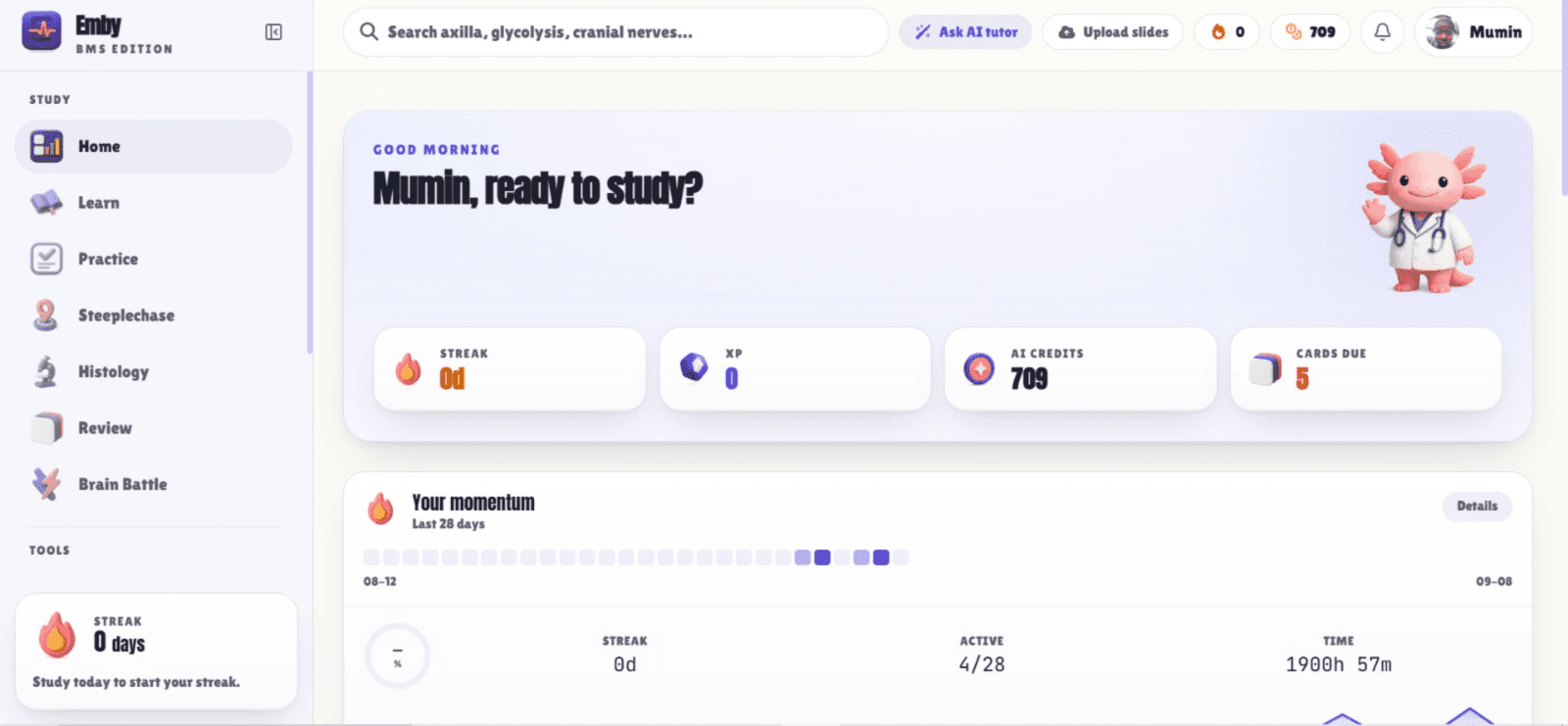
Medical school has endless content, but a severe lack of feedback.
Students can spend hours reading lecture slides and textbooks, but have almost zero visibility into their actual weaknesses until a final exam exposes them.
When I talked with my classmates, a pattern emerged: they didn't need another place to store PDFs. They needed a better feedback loop to test what they actually knew.
Building a continuous feedback loop.
I led the product strategy, design, and frontend engineering to build Emby—a platform focused entirely on turning study material into active practice.
The core interface was designed to support a single, connected flow:
Translating noise into a focused component architecture.
The hardest part of building Emby wasn't writing the Next.js or Tailwind code. It was deciding what not to build.
User research generates a massive wishlist. I had to filter the noise and translate raw requirements into a maintainable frontend system. Instead of treating every request as a new screen, I built a modular component architecture that prioritized exactly three things:
- 1. WHERE AM I?
- 2. WHAT CAN I DO HERE?
- 3. WHAT SHOULD I DO NEXT?
Emby is currently pre-launch with an active waitlist.
Building it reinforced a critical lesson: a frontend interface doesn't exist independently of the system behind it.
The takeaway
Good frontend engineering isn't just about building screens that look good—it's about shaping systems that have a reason to exist.